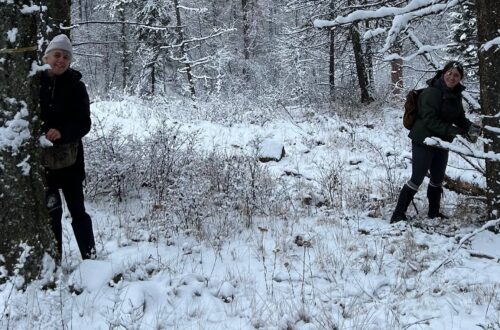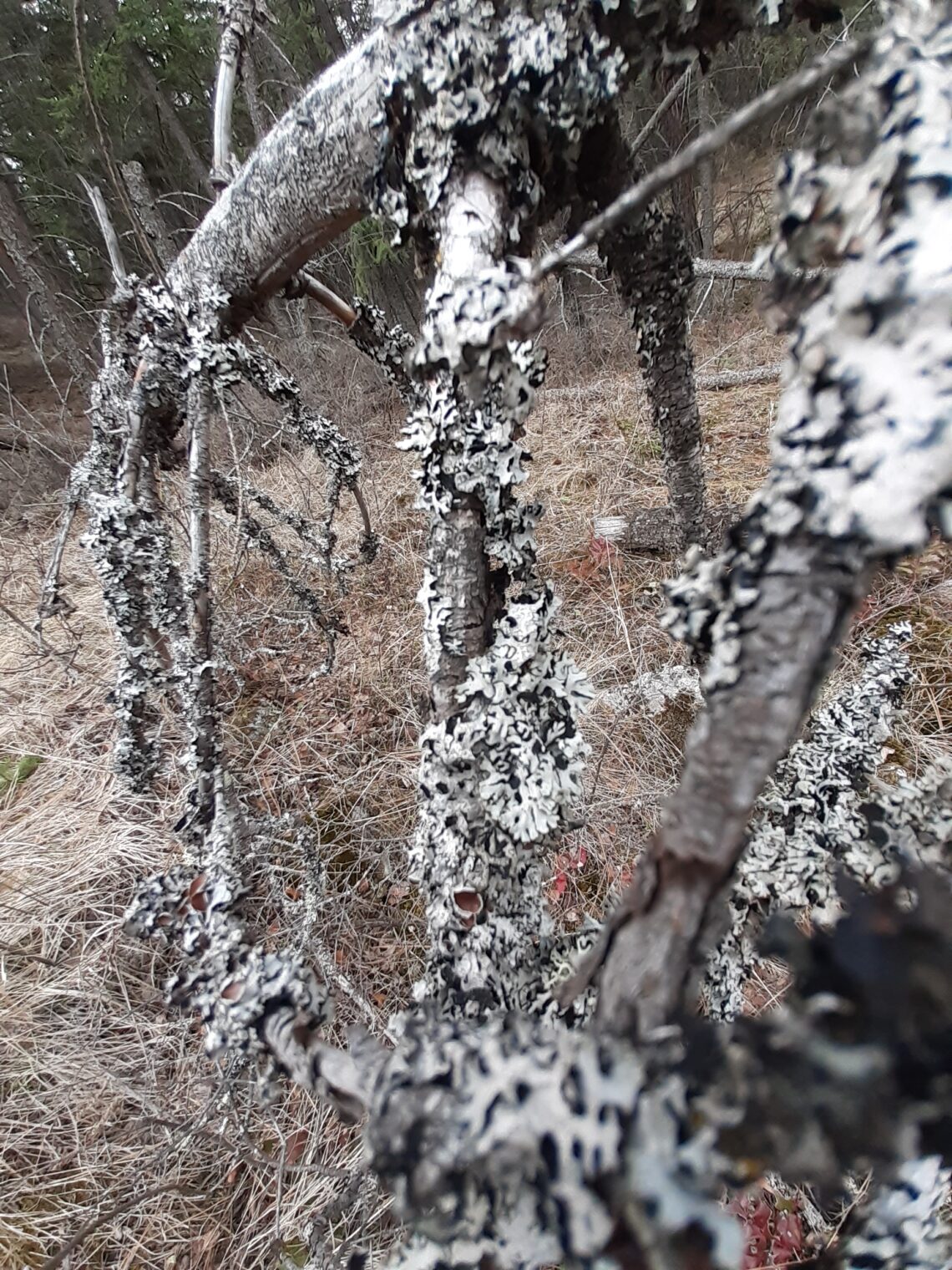

So April 6th was our first spring foraging run. The original goal was to see how the yarrow is growing at one of our zones after observing it doing very well at the horse barn. We did come back with a bit of yarrow, but not without observing just how many fir sprigs and branches had blown off the Douglas fir trees in the same area. We ended up gathering a full cloth grocery bag of fallen, still-green, fir sprigs!

Along the way, we observed that the animals hadn’t bothered to eat the fruit of the kinnickinick plants, and now those berries are very much over-ripe and smell fermented when you open them. These plants were right beside a dirt bike trail, and we wonder if that activity scared off the critters. We’ll watch these patches this year.

We observed Arnica starting to grow, false solomon’s seal poking leafy spires out of the dirt, and found several patches of desert parsley to remember in a couple weeks’ time. Arrowleaf Balsamroot is starting to flower now, with the flowers coming before the leaves do. We need more leaf this year for Bella’s potential allergy reactions to things this year. It really helps to tamp down her allergy bouts.

Stonecrop was also observed to be growing in a few places on this particular trail, along with avens and cinquefoil. I spotted a strawberry plant as well, and grabbed a few 3-flowered aven leaves to add to our Passover greens on Wednesday this week.

Then we spotted a Ponderosa pine with very loose bark layers. These layers are what I’ve been experimenting with as a cinnamon-like spice, and that is ground up and added to the newest tea on the table: Wild Apple Spice. Not going for the cambium layer, and watching the depth of the outer bark, gives us a marker to watch for when gathering bark layers. We know when to stop without threatening the tree in any way.

Looking around at the base of a few pine trees reveals that the trees shed this layer regardless. We can either let it go to waste and become forest fire fuel, or we can do our part in reducing fuel for forest fires while also reducing our need to buy imported goods from overseas.
Foods that come from out of town have to get here somehow. Generally, they are flown in, or trucked in. If they come from overseas, they either come by ship or by plane as well. But whether it’s brought in from out of town, out of country, or within the local region, the “last mile” as they call it, is by vehicle. Vehicles require fuel to run, whether we’re talking propane, gasoline, diesel, or electricity. Yes i listed electricity as a fuel, because the electrical company has learned they can charge more to charge vehicles than they charge to power homes or businesses. Here in BC, Canada, most of our electricity is generated via turbines in water, but the advent of electric vehicles has both our electrical companies buying electricity from other sources now, to shore up the demand on the province’s power grid. In the US, photos have surfaced where the occasional charging station is positioned not far from a diesel generator! I get that businesses, corporations, and camping die-hards also use diesel generators to power essentials and keep the lights on, but it’s laughable when such technology is pared with electric vehicles. Suddenly any environmental claims evaporate in so much hot air.
 The other side to everything being trucked that last mile from farm to store, or from customs to the store, or from a warehouse to the store, is that fuel prices go up and down at the whim of jumpy investors on wallstreet. If someone scary shouts “boo!”, suddenly the prices for various stocks go up, which includes fuel prices. While this makes no sense to someone who feels local fuel should not be tied to world markets, it’s happening just the same, and products relying on that transportation have to cover their cost for getting to you, so their prices go up as well. We are now being threatened with potential grocery prices across Canada skyrocketing for no other reason than jumpy investors spiking fuel prices because of the Iran war. Well, one other reason may hike prices as well, because apparently, fertilizer used on Canadian farms gets imported from countries around the Strait of Hormuz. . . which Iran is trying to use as a choke point. This could jack food prices up not just in the short term, but next year as well for foods that were grown this year intended for sale next year (such as grains and flour).

So what does a forager do? Learn, act and prepare. I already know what’s now possible using curly dock flour. Ashley has learned a few things she can do with corn flour. We’ve learned that Ponderosa pine bark is an amazingly similar flavour to cinnamon and can be used in all the same ways. We know where to find wild salad fixings, and that we can dry those greens for use in soups, stews, and teas out of season. We’ve learned many wild herbs that are good for a wide range of ailments and health situations. We continue to learn, and that includes discovering that the root of scotch thistle tastes amazing raw, and goes well with my cheesy carrot chickpea humus. It also cooks up soft and absorbs flavours around it, much the way mushrooms do. It will be our root starch for our Passover meal this week.
Roots were a big way that local first nations peoples ensured solid meals. Some roots would be pit-cooked for hours or even days before use. Other roots went into the soup or stew pot. I threw in frozen scotch thistle root into a pot of chilli recently, where it cooked for the better part of 1.5 hours, and turned out with a nice texture and of course, tasting like the chilli spices.
Discovering that Lamb’s Quarters are a spinach substitute whether raw or cooked, is another ingredient that doesn’t need to be trucked the last mile if it is found growing nearby, or only the price of the gas spent to go get it, which for us, is equal to the cost of gas running to the store. Of course, the fewer runs to the store, the less gas spent. Money saved all around.
If you want to reduce fuel price impacts on your groceries, the other way to do it is by visiting farm stands nearby. The farmer then doesn’t have to spend that gas himself, which makes doing business more affordable for him too, and your supporting local.
Needless to say, for these and other household reasons, the spices we cook and bake with are becoming decidedly more North American, and more regional even than that. The foods we eat are changing to become something akin to mexican meets Okanagan first nation, and our medicine is decidedly more local as well.
Maybe this week I’ll get around to trying out powdered pine bark in place of cinnamon in a cinnamon roll recipe. If it works, I’ll share the recipe and call them pine rolls instead. We haven’t tested the bark powder of lodgepole in our area, nor of other breeds of pine, but if you’re adventurous and want to share in the experiment, be ethical and responsible with your bark harvesting, if the bark is wet, let it dry, then powder it and tell me what you did with it. If you’re on my newsletter mailing list, simply respond to that email address. If you follow me on social media, share with me the results of your experiment there. The flavours we taste are similar but not exactly the same as cinnamon. Close enough though, that the flavour is swappable, with a vanilla aftertaste, which is not at all unpleasant.
 We will be at the Vernon Wellness Fair April 11th and 12th, with a sniff sample available of Wild Apple Spice. If fair prep goes well this week, we may have more samples available for sale too. The two we had are gone. We don’t use any anti-caking agents, so it does need breaking up a bit before each use, but it breaks up very easily as we’ll demonstrate this weekend.
If you live in the Okanagan, hope to see you at the fair, and we look forward to more foraging runs, workshops, etc, as the year progresses. Don’t forget that we are available for various bookings this year. See the booking card below: